In this article, we break down key considerations, best practices, and practical tips to help businesses make informed decisions about their office technology and communication systems.
Eco-Solvent vs. Resin vs. UV Ink: Which Large Format Printing Technology Is Right for Your Applications?
When evaluating large format printing equipment, one of the biggest decisions isn't necessarily the printer itself. It's the ink technology behind it.
Eco-solvent, resin, and UV inks each offer unique advantages, and the best choice often depends on the types of products you're producing, the environments those products will be used in, and your business's long-term goals.
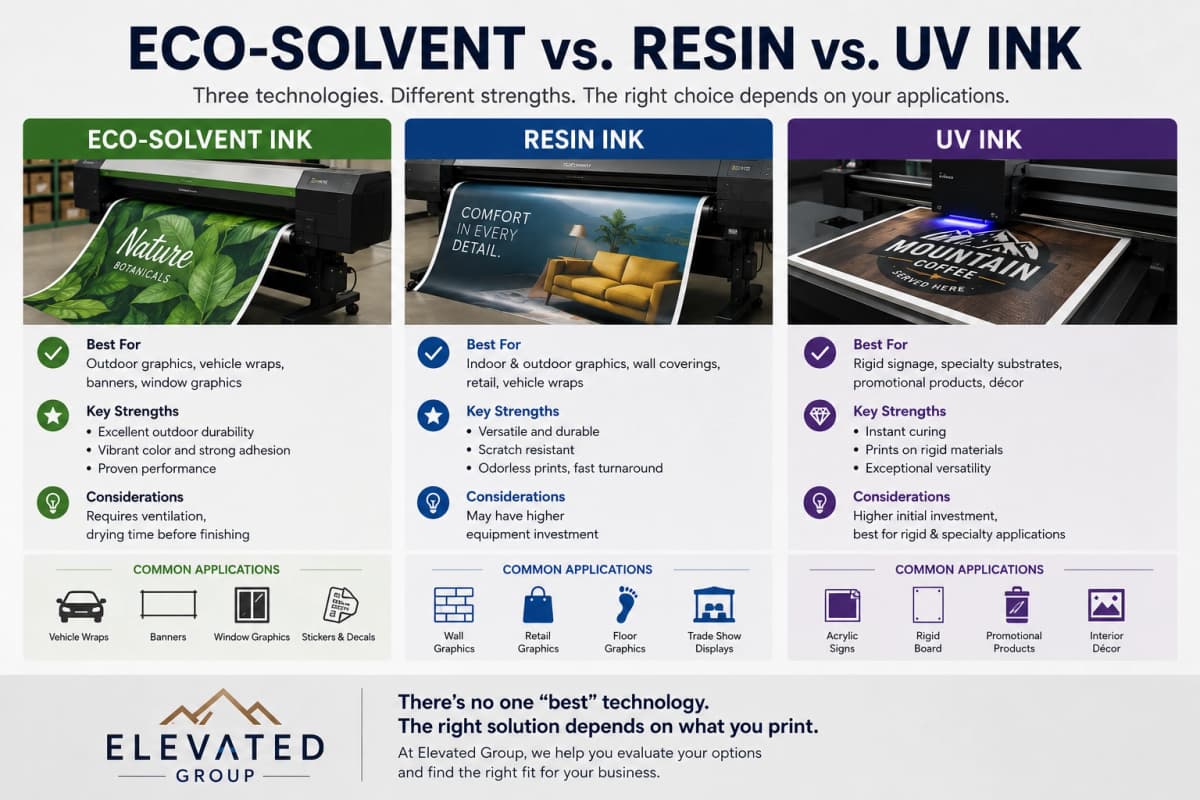
At Elevated Group, we work with businesses across a wide range of industries, from sign shops and vehicle wrap providers to manufacturers and commercial print operations. One thing we've learned is that there is no single "best" ink technology. Each has strengths that make it a great fit for certain applications.
Let's take a closer look at what sets each option apart.
Eco-Solvent Ink
Eco-solvent technology has been a staple in the sign and graphics industry for years. It remains one of the most popular choices for businesses producing outdoor graphics and vehicle wraps.
Eco-solvent inks penetrate the surface of compatible media, creating durable prints with vibrant color and strong outdoor performance.
Where Eco-Solvent Excels
Eco-solvent is known for:
- Excellent outdoor durability
- Vibrant color reproduction
- Strong adhesion on vinyl media
- Proven performance for vehicle graphics
- Lower equipment investment compared to some alternatives
Because of its durability and flexibility, eco-solvent continues to be a popular choice for sign shops that produce a high volume of decals, banners, and wraps.
Common Applications
- Vehicle wraps
- Fleet graphics
- Window graphics
- Stickers and decals
- Outdoor signage
- Banners
- Wall graphics
Things to Consider
Eco-solvent technology typically requires ventilation considerations and print drying time before finishing or lamination. While image quality remains excellent, newer technologies have expanded the range of applications available to print providers.
Resin Ink
Resin printing has gained significant popularity in recent years because it combines many of the benefits of eco-solvent and latex technologies while offering exceptional versatility.
Resin inks cure at relatively low temperatures and produce durable, scratch-resistant graphics without many of the environmental concerns associated with traditional solvent printing.
Where Resin Excels
Resin technology is known for:
- Excellent color consistency
- Fast turnaround times
- Durable scratch-resistant output
- Broad media compatibility
- Indoor and outdoor versatility
- Odorless prints suitable for sensitive environments
Many print providers appreciate resin because it allows them to produce everything from banners and wraps to interior graphics using a single platform.
Common Applications
- Retail graphics
- Wall coverings
- Vehicle wraps
- Floor graphics
- Window graphics
- Banners
- Trade show displays
- Interior décor
Things to Consider
For businesses looking for a versatile production platform that can handle both indoor and outdoor work, resin often provides an excellent balance of quality, durability, and flexibility.
UV Ink
UV printing takes a completely different approach.
Instead of absorbing into the media, UV inks cure instantly when exposed to ultraviolet light. This creates a durable image that sits on top of the substrate and allows printing on a much wider range of materials.
This versatility has made UV one of the fastest-growing technologies in large format printing.
Where UV Excels
UV technology is known for:
- Instant curing
- Printing on rigid materials
- Exceptional substrate versatility
- High durability
- Specialty print applications
- White ink and clear ink capabilities
One of the biggest advantages of UV printing is the ability to print directly onto materials that traditional roll-to-roll printers cannot handle.
Common Applications
- Acrylic signs
- PVC boards
- Foam board
- Corrugated plastic
- Metal panels
- Wood products
- Glass graphics
- Packaging prototypes
- Promotional products
- Interior décor
- ADA signage
Things to Consider
If your business produces rigid signage, custom displays, industrial graphics, or specialty products, UV technology can open doors to applications that simply aren't possible with traditional solvent-based systems.
Which Technology Is Best?
The answer depends entirely on what you're producing.
A vehicle wrap company may find eco-solvent or resin to be the ideal fit.
A sign shop producing both indoor and outdoor graphics may benefit from the versatility of resin technology.
A graphics company looking to expand into rigid signage, décor products, or specialty applications may find UV printing to be the best investment.
In many cases, successful print providers utilize more than one technology because each serves a different purpose.
Choosing the Right Solution for Your Business
Rather than asking which ink technology is best, a better question is:
"Which technology is best for the products we want to sell?"
That's where a consultative approach becomes valuable.
At Elevated Group, we work with businesses to understand their current applications, future growth plans, and production goals before recommending equipment. Whether you're focused on vehicle wraps, signage, retail graphics, interior décor, packaging, or industrial printing, there is likely a solution that aligns with your objectives.
The right technology isn't determined by industry trends. It's determined by your workflow, your customers, and the products you want to create.
If you're exploring large format printing equipment and aren't sure whether eco-solvent, resin, or UV technology makes the most sense for your operation, our team would be happy to help you evaluate your options and find the right fit.